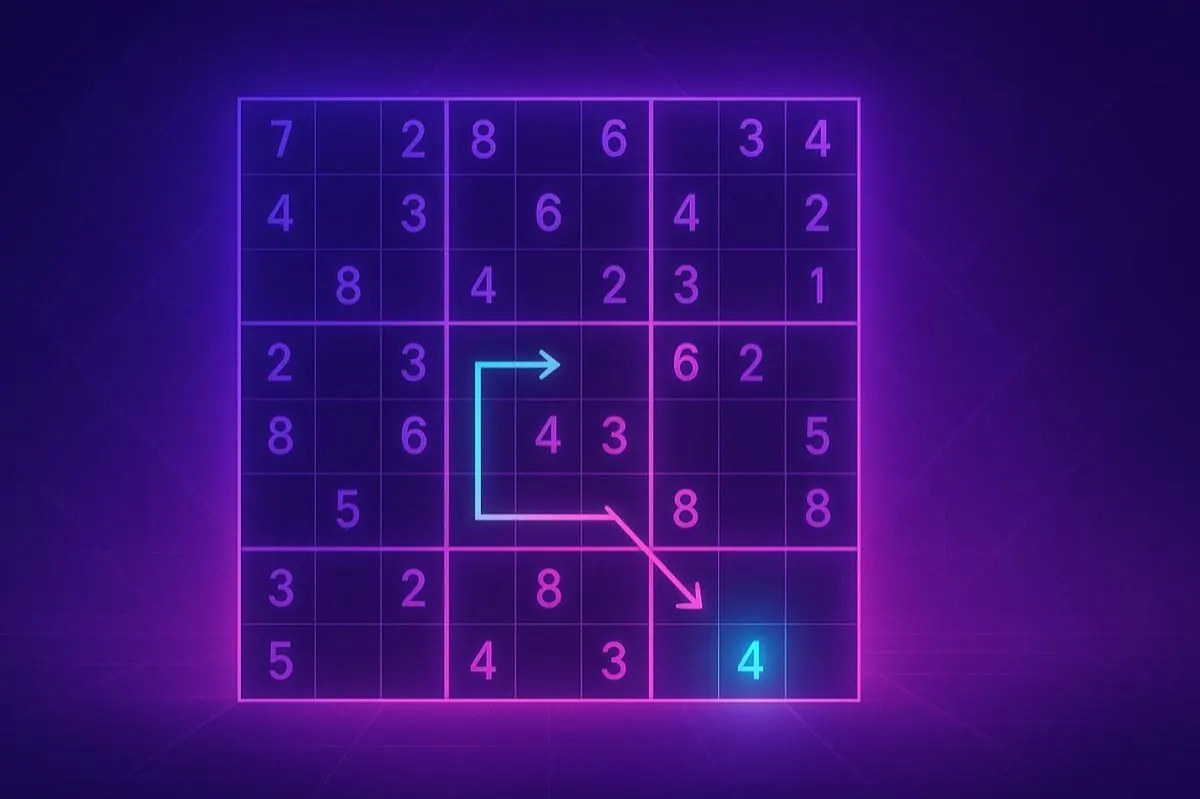
Step 1: Start with the most crowded rows, columns, or boxes
When a puzzle first opens, do not try to solve everything at once. Scan for the areas that already have many numbers. These are the places where the missing values are easiest to identify. If a row has only one empty cell, that move is almost always the best place to begin. If a box is missing only two or three digits, compare those missing numbers against the rows and columns crossing the open cells.
Step 2: Ask what is missing
The simplest and strongest question in Sudoku is: which numbers are missing here? Ask it about one row, one column, or one box at a time. Write down the missing digits mentally, then test where each one can go. This keeps the puzzle small enough to think clearly about. A board feels complicated when you look at all 81 cells at once. It feels manageable when you reduce it to one missing set.
Step 3: Use scanning technique
The scanning technique means moving across rows, down columns, and around boxes looking for easy restrictions. A number may already exist elsewhere in the row, so one open cell is blocked. It may also appear in the column, which blocks another. This kind of scan is the most basic strategy in Sudoku, and it solves a lot of boards on its own.
Many beginners think scanning is too simple to matter. In practice, it is the base layer under almost every other strategy. If your scanning improves, your whole solve improves.
Step 4: Use elimination method
Elimination means removing impossible options until only one remains. Imagine a box is missing 2, 5, and 9. One empty cell sits in a row that already has 2 and 9. That cell cannot be either of those values, so it must be 5. You did not guess. You eliminated everything else. That is exactly how Sudoku is meant to work.
The elimination method is useful on every level, from easy to hard. The harder the puzzle, the more patiently you need to apply it.
Step 5: Recheck the affected area after every move
Once you place a number, do not jump to a random part of the board. First recheck the same row, the same column, and the same box. One good placement often creates another nearby. This local loop is one of the best ways to keep the solve flowing. A lot of progress in Sudoku comes from these short chains rather than isolated brilliant moments.
Step 6: Look for singles
A single is either a cell with only one valid value left or a number that can go in only one position within a row, column, or box. Singles are your best friends. They create certainty, and certainty creates momentum. On easier boards, most of the solve may come from spotting singles cleanly. On harder boards, singles still matter because they often appear after a few rounds of elimination.
Step 7: Do not guess unless you are intentionally testing yourself
Can Sudoku be solved by guessing? A person can guess, but good Sudoku should not require blind guessing. If you want to get better, guessing is usually a bad habit. It hides weak spots in your process and can make the board messy very quickly. Instead, leave an uncertain cell alone and search somewhere else. Another correct move may unlock it naturally.
Step 8: Know what advanced terms mean, but do not depend on them too early
Players often hear terms like X-Wing or Swordfish and think they need them right away. Those are real advanced techniques, but most players should first build strong scanning, elimination, and consistency. If your basics are shaky, advanced names will not fix the underlying problem. They only become useful once your core reading of the grid is solid.
Step 9: Practice on the right level
If you are learning, use easy Sudoku to make the method feel natural. Then move into medium when the board no longer feels overwhelming. Save hard puzzles for the point where you can already explain your moves with confidence. If you want one repeatable daily test, use the daily puzzle.
Step 10: Get better through repetition, not speed alone
The best way to improve is to repeat a clean process. Read the grid. Find the missing numbers. Scan. Eliminate. Recheck. Place only what you can justify. That routine may feel slow at first, but speed usually grows naturally once your eyes learn what to look for. Strong players are often fast because they are clear, not because they are reckless.
Where techniques like X-Wing and Swordfish fit
X-Wing and Swordfish are higher-level pattern techniques used mostly on harder puzzles. They matter, but they are not the first place to start. Think of them as later extensions of the same logic mind-set. They still depend on noticing where numbers can and cannot go. If you are not there yet, that is fine. You can solve a lot of Sudoku without using those advanced tools at all.
Final thought
The easiest way to solve Sudoku is not a shortcut. It is a reliable routine. Step-by-step solving gives you control over the board, reduces careless mistakes, and makes difficult puzzles feel less mysterious. If you want to strengthen that routine even more, pair this page with our guides to Sudoku tips, basic strategies, and why Sudoku feels hard.